
In-process turbidity measurement is an important parameter for assessing the quality of liquids directly during ongoing production. To ensure that measured values are comparable, guidelines for turbidity measurement have been published in the fields of industry, water treatment and brewing. In the industrial sector, the wide range of applications and their requirements have also led to plant- and application-specific regulations.
Transmitted light or absorption turbidity measurement is probably the most widely used turbidity measurement technique and is well suited for measuring ranges of approx. 40 – 40000 TEF. Turbidity is typically measured at a wavelength above 750nm, so that color influences (dyes absorb in the visible range of light from approx. 400-700nm) cannot affect the turbidity value. The measuring method is described, for example, in the German standard DIN 38404 Part 2 and its European version EN 27027.
The standard describes the method using a transparency cylinder and viewing disc, in addition to the 90° scattered light method. It also contains detailed instructions for preparing a 400 NTU formazin solution and for calibrating turbidity meters. The transmitted light method is recommended for turbidities above 40 NTU.
% (percent transmission) A* (spectral absorbance)
* Spectral absorbance is also referred to as EXT (extinction), CU (Concentration Unit), AU (Absorption Unit) or OD (Optical Density).
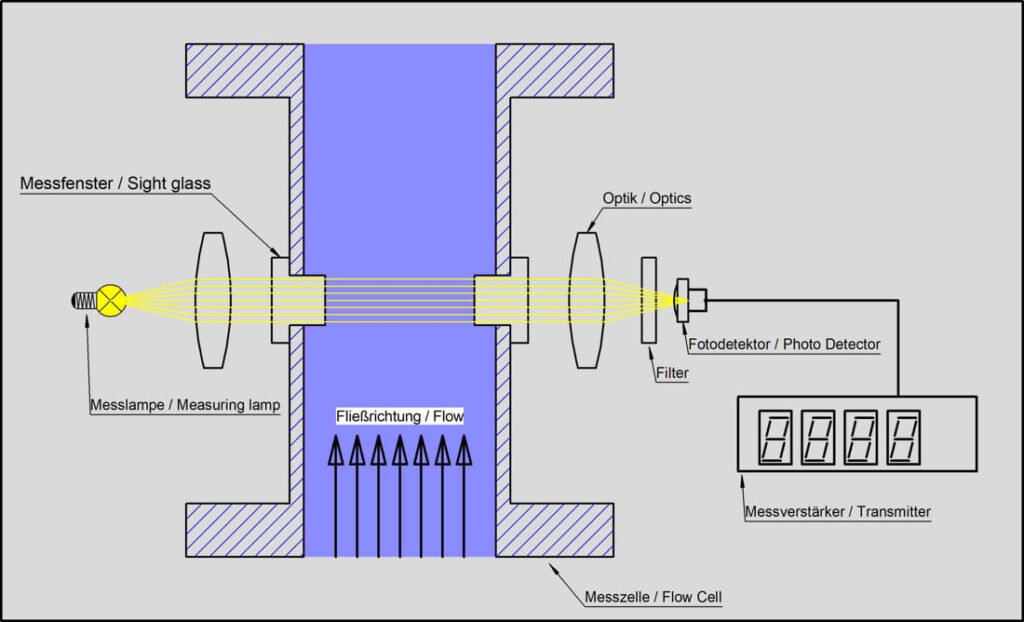
The measuring lamp sends a focused beam of light through the liquid stream by means of optics. This light beam is scattered by the particles present in the liquid stream. The scattered light detectors capture the resulting scattered light. In modern turbidity meters, a detector opposite the light source additionally captures the transmitted light.
The signals from the scattered and transmitted light detectors are combined by the electronics.
The ratio of the two signals forms the turbidity value and is displayed as the measurement result.
The particles in the liquid stream weaken the intensity of the transmitted light but increase the proportion of scattered light.
The result of the ratio (scattered light / transmitted light = measured value) increases.
Dyes dissolved in the liquid weaken both the transmitted and the scattered light. The result of the ratio (scattered light / transmitted light = measured value) remains constant.
In this way, only particles are taken into account in the measurement results. Undesirable influences such as strong coloration, window fouling or aging of the measuring lamp are compensated.
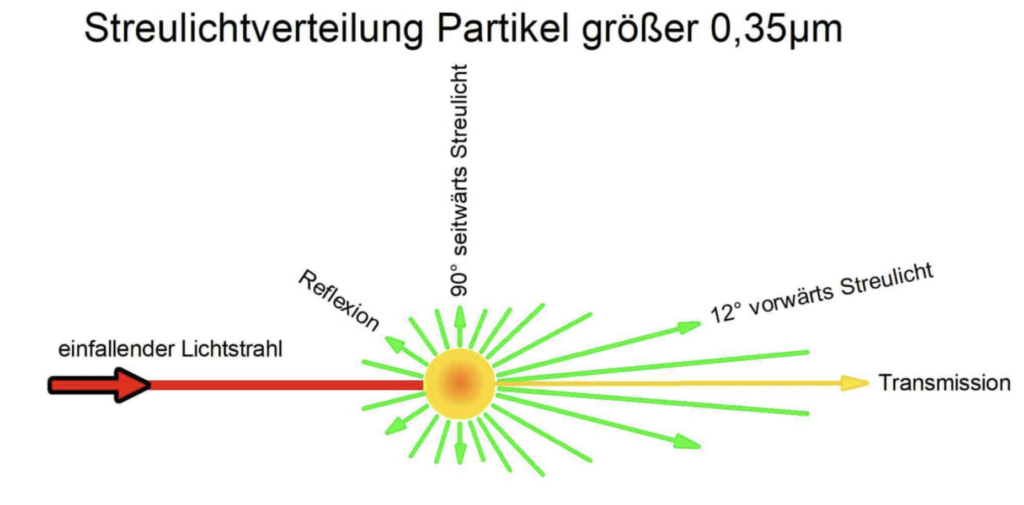
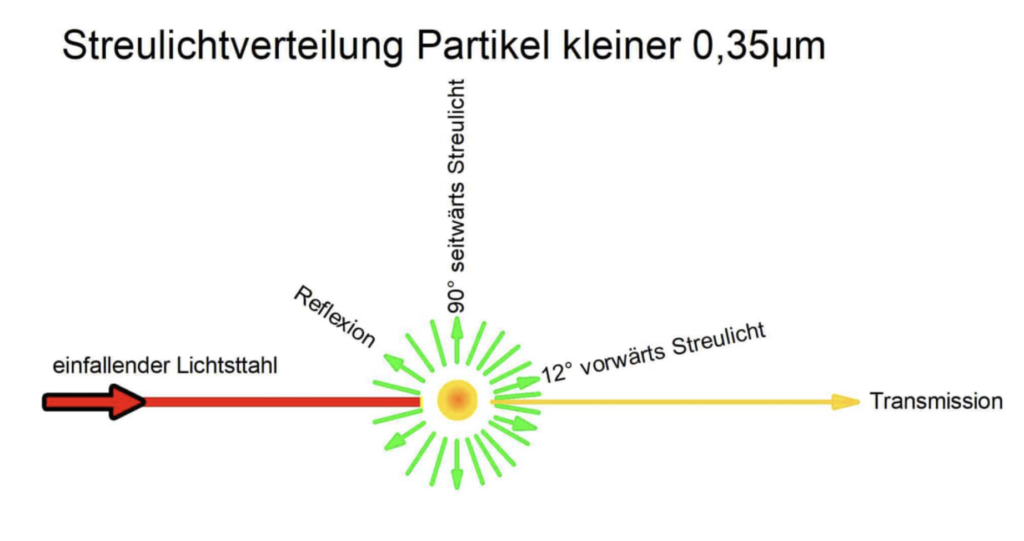
With the 90° method, small particles and large particles produce a similarly high scattered light intensity. With the 12° method, small particles produce a low and large particles a high scattered light intensity. With a particle size distribution of approx. 0.3 µm (formazin), the particles produce roughly the same scattered light intensity with both methods. Combining both measuring methods therefore indicates a tendency of the particle size distribution in the product. If the measured value of the 90° measurement is greater than that of the 12° measurement, the average particle size is below 0.3 µm. If the measured value of the 90° measurement is smaller than that of the 12° measurement, the average particle size is above 0.3 µm.
| Particle size | Measurement result 90° scattered light | Measurement result 12° scattered light |
|---|---|---|
| greater than 0.3 µm | Lower | Higher |
| less than 0.3 µm | Higher | Lower |
Example filter monitoring: 90° side scatter: Small particles (e.g. proteins) within the filtered product are displayed with very good resolution. However, a filter breakthrough is detected with a delay, as this is normally a slow process in which only a few large particles enter the filtrate at first. The total number of particles initially increases only insignificantly, so the measured value also rises only insignificantly.12° forward scatter: Small particles (e.g. proteins) within the filtered product are displayed with good resolution. A filter breakthrough is detected early due to large particles (filter aids, yeast cells, etc.). The isolated large particles at the start of a filter breakthrough are detected immediately and the measured value rises sharply. This mass-related measuring method allows, with restrictions, calibration in mg/l.
International Organization for Standardization: ISO on the web
German Institute for Standardization (DIN e. V.): DIN/EN on the web
DIN’s standardization work supports the economic goal of world trade free of technical barriers and of a common market in Europe. This requires international and European standards. European standardization is carried out within the framework of the three organizations CEN (Comité Européen de Normalisation), CENELEC (Comité Européen de Normalisation Electrotechnique) and ETSI (European Telecommunications Standards Institute).
The national member organizations vote on European standards and implement them. With the exception of ETSI, the standardization organizations have only one member per country, which represents all the standardization interests of that country. In votes, members have different numbers of votes according to their economic strength. German interests in Europe are represented by DIN Deutsches Institut für Normung e. V.
| Measuring principle: | Ratio measurement: scattered light/transmission |
|---|---|
| Measuring angle: | 90° ±2,5° |
| Beam dimension: | 0° with maximum 1.5° convergence |
| Measuring wavelength: | 860 nm / tolerance ±30 nm |
| Calibration standard: | Formazin |
| Measuring principle: | Ratio measurement: scattered light/transmission |
|---|---|
| Measuring angle: | 90° ±2,5° |
| Beam dimension: | 0° with maximum 1.5° convergence |
| Measuring wavelength: | 860 nm / tolerance ±30 nm |
| Calibration standard: | Formazin |
The US Environmental Protection Agency is an agency of the government of the United States of America for the protection of the environment and human health. The EPA was founded under President Nixon on December 2, 1970. The agency is headquartered in Washington, D.C. Its head (Administrator) is Stephen L. Johnson, his deputy is Marcus Peacock. The agency employs 17,000 people.
It is intended to “accompany” the implementation of environmental protection laws. Since 1982, the Office of Criminal Enforcement, Forensics and Training, abbreviated OCEFT, has existed as a separate enforcement and investigation authority. It has had full police powers since 1988. (OCEFT on the web) The US EPA requirements for turbidity measurement differ from the ISO / EN / DIN requirements.
| Measuring principle: | Ratio measurement: scattered light/transmission |
|---|---|
| Measuring angle: | 90° ±2,5° |
| Beam dimension: | 0° with maximum 1.5° convergence |
| Measuring wavelength: | 860 nm / tolerance ±30 nm |
| Calibration standard: | Formazin |
The Central European Brewing Analysis Commission (Mitteleuropäische Brautechnische Analysenkommission e. V., MEBAK) brings together the state and private brewing institutes of Germany, Austria, the Czech Republic and Switzerland as well as the respective national brewing industries.
The purpose of the association is to develop principles and methods for the analysis of raw materials, intermediate, by- and finished products, additives and technical processing aids, containers and packaging materials with the aim of standardization, preferably in the field of malting and brewing.
MEBAK has published a collection of brewing analysis methods in five volumes, which have become widely used internationally and serve as teaching material at various education and training institutions for brewing (e.g. TU Munich-Weihenstephan, Doemens Academy).
| Recommendation Brewing Analysis Methods Volume II 2.15.1.2 Stability | |
|---|---|
| Measuring principle: | Ratio measurement: scattered light/transmission |
| Measuring angle: | 90° ±2,5° |
| Beam dimension: | 0° with maximum ±1.5° tolerance |
| Measuring wavelength: | 650 nm / tolerance ±30 nm |
| Calibration standard: | Formazin / alternatively: AEPA turbidity standard (styrene-divinylbenzene) |
| Filter monitoring (in addition to the 90° measuring angle specified above) | |
|---|---|
| Measuring principle: | Ratio measurement: scattered light/transmission |
| Measuring angle: | 11° – 25° |
| Beam dimension: | not specified |
| Measuring wavelength: | not specified |
| Calibration standard: | Formazin |
| Recommendation Brewing Analysis Methods Volume II 1.3 Lauter wort | |
|---|---|
| Measuring principle: | Ratio measurement: scattered light/transmission |
| Measuring angle: | 11° – 25° |
| Beam dimension: | not specified |
| Measuring wavelength: | not specified |
| Calibration standard: | Formazin |
European Brewery Convention; promotes, among other things, brewing science activities in Europe. EBC units are used to state, among other things, beer turbidity, beer color and the bitterness value of a beer. The European Brewery Convention was founded in 1947 to support malting and brewing science. Its aim was and still is the development of analytical methods to ensure beer quality and to promote consistently high quality of raw materials and brewing processes.
Over the years, this successful work led to the standardization of many processes, such as in-process turbidity measurement, and thus to increasing product safety and process hygiene. Against this background, the EBC founded a Technology and Engineering Forum in 1990 with the task of developing the simplest possible technical procedures for optimizing production and quality assurance in malting and brewing.
| Filter monitoring (in addition to the 90° measuring angle specified above) | |
|---|---|
| Measuring principle: | Ratio measurement: scattered light/transmission |
| Measuring angle: | 11° – 13° |
| Beam dimension: | not specified |
| Measuring wavelength: | not specified |
| Calibration standard: | Formazin / alternatively: AEPA standard (styrene-divinylbenzene) |
| Stability | |
|---|---|
| Measuring principle: | Ratio measurement: scattered light/transmission |
| Measuring angle: | 90°, no tolerance specified |
| Beam dimension: | not specified |
| Measuring wavelength: | not specified |
| Calibration standard: | Formazin / alternatively: AEPA turbidity standard (styrene-divinylbenzene) |
Like the EBC, the ASBC publishes standard methods and has, among other things, published calibration units for turbidity meters. The ASBC unit is rarely or not used in Europe and has largely been replaced by the EBC unit even in the USA.
recommended guidelines for in-process turbidity measurement that are based on the EBC.
| Measuring principle: | no specification |
|---|---|
| Measuring angle: | no specification |
| Beam dimension: | no specification |
| Measuring wavelength: | 580 nm |
| Calibration standard: | Formazin / unit of measurement ASBC1 |
The Institute of Brewing & Distilling (IOB or IBD) is an organization dedicated to the education and training of brewers and distillers. Like the EBC and ASBC, the IOB has
recommended guidelines for in-process turbidity measurement that are based on the EBC.
| Stability | |
|---|---|
| Measuring principle: | Ratio measurement: scattered light/transmission |
| Measuring angle: | 90°, no tolerance specified |
| Beam dimension: | not specified |
| Measuring wavelength: | not specified |
| Calibration standard: | Formazin / alternatively: AEPA turbidity standard (styrene-divinylbenzene) |
| Filter monitoring (in addition to the 90° measuring angle specified above) | |
|---|---|
| Measuring principle: | Ratio measurement: scattered light/transmission |
| Measuring angle: | 11° – 13° |
| Beam dimension: | not specified |
| Measuring wavelength: | not specified |
| Calibration standard: | Formazin / alternatively: AEPA turbidity standard (styrene-divinylbenzene) |
Formazin solution is a toxic substance! Please be sure to observe the safety instructions for handling formazin.
Formazin: An aqueous suspension of an insoluble polymer. Formazin is formed by the reaction between a hydrazinium sulfate and hexamethylenetetramine and has an average particle size of 1.5 µm with a standard deviation of 0.6µm.
For calibrating turbidity meters, preparing a formazin stock solution of 1000EBC / 4000 TEF is recommended*. This comparatively high concentration offers better storage life of up to 6 months. However, the stability of the formazin suspension depends heavily on the storage conditions. The formazin solution should be stored in the dark at a temperature of approx. 10°C.
Before use, the solution must be shaken very thoroughly for at least 2 minutes. Then let it rest for at least 15 minutes to degas, and swirl it gently once more immediately before use to homogenize the suspension. Make sure that no air bubbles are introduced.
Any calibration solutions < 1000EBC / 4000 TEF can be prepared from this stock solution by diluting with distilled water.
However, different rules apply to the preparation of calibration solutions below 0.5 EBC; here, specially distilled and filtered water and a precision balance are used. Please also note that the diluted calibration solutions are considerably less stable than the 1000EBC / 4000 TEF suspension. You should always prepare diluted standards on the day of use and use them immediately.
* DIN/EN 27027 (ISO 7027) specification, suspension of 100EBC (400TEF), shelf life max. 2 weeks.
Turbidity units based on formazin
The undiluted solution has a turbidity value of:
1000 EBC (European Brewery Convention) 4000 TEF (Formazin Turbidity Units, German: Trübungseinheiten Formazin) 4000 FTU (Formazin Turbidity Units) 4000 FNU (Formazin Nephelometric Units, unit only for 90° scattered light measurement) 4000 FAU (Formazin Attenuation Units, unit acc. to EN27027 turbidity in transmitted light method above 40 FNU) 40000 Helm units 69000 ASBC (American Society of Brewing Chemists)
Safety instructions for handling kieselguhr
Kieselguhr, also known as diatomaceous earth (DE), is a whitish, powdery substance consisting mainly of the silicon dioxide shells of fossil diatoms. Kieselguhr is frequently used to calibrate turbidity meters. Since kieselguhr is available in different grades and grain sizes, different conversion factors compared to formazin can be found in the literature. Kieselguhr has the advantage that the dry powder has a virtually unlimited shelf life.
However, the actual calibration standard can only be used for a few hours, as kieselguhr swells in water. When calibrating with kieselguhr, ensure homogeneous distribution (constant stirring), as kieselguhr tends to sediment. Kieselguhr is available from different suppliers and in different particle sizes; to ensure reproducible calibration, the manufacturer, particle size and batch number of the kieselguhr should always be kept the same.
Typical turbidity units based on the kieselguhr standard:
JTU* (Jackson Turbidity Unit) JCU* (Jackson Candle Units) ppb (parts per billion) ppm (parts per million) g/l (grams per liter) mg/l (milligrams per liter) %TS (percent total solids)
* The units JTU and JCU are based on the Jackson Candle Turbidimeter (Jackson candle tube), the predecessor of modern forward scatter measurement, and are no longer in use today
Benefit from over 40 years of experience, field-proven measurement technology and personal consultation. Together we will find the right solution for your application. Visit our contact page and tell us about your project for a non-binding quote.
You need to load content from reCAPTCHA to submit the form. Please note that doing so will share data with third-party providers.
More InformationYou need to load content from Turnstile to submit the form. Please note that doing so will share data with third-party providers.
More InformationYou are currently viewing a placeholder content from Vimeo. To access the actual content, click the button below. Please note that doing so will share data with third-party providers.
More InformationYou are currently viewing a placeholder content from YouTube. To access the actual content, click the button below. Please note that doing so will share data with third-party providers.
More InformationYou need to load content from reCAPTCHA to submit the form. Please note that doing so will share data with third-party providers.
More Information