

Oil-on-Water Detection Using an Infrared Surface Scanner

Oil-on-water detection by infrared scanning with the IRmat model (IR21) is a contactless and virtually maintenance-free method for detecting floating oil on water surfaces.

Contents

Click on a section to jump to the right place

The Task

Measuring Oil on Water

According to the German Water Resources Act (WHG, §1), “everyone is obliged … to exercise the care required by the circumstances in order to prevent contamination of water …”. For facilities where there is a risk that oils may enter a body of water in the event of operational malfunctions, the required care calls for continuous monitoring of the outlet.

Since the outlets of facilities that may contain oil do not carry clean water but typically cooling water or wastewater, this water often still contains a considerable load of contaminants (sand, mud, silt, algae, salts, etc.). In addition, operating conditions such as temperature, flow velocity and fill level are not constant. These boundary conditions often mean that oil cannot be detected reliably. When measuring in open channels, basins, tanks or larger pipelines, only a portion of the water is ever captured. Taking a representative sample with an average oil content is therefore practically impossible, as the oil distribution within the water flow fluctuates unpredictably depending on water depth, temperature, flow velocity and type of oil.

Almost all types of oil, or at least their components, are lighter than water and therefore tend to float. For this reason, the highest oil concentration is to be expected at the water surface and in the upper section of large pipelines. The IRmat model (IR-21) makes use of this flotation effect to ensure maximum response sensitivity.

Overview of Different Measuring Methods

Numerous methods are used to detect oil on water:

  • IR surface scanning
  • UV-induced fluorescence
  • Ultrasonic reflection
  • Light scattering / turbidity measurement
  • Conductivity measurements at the water surface
  • Capacitive measurements
  • Transfer of oil into a hydrocarbon solvent and spectroscopic analysis of the solvent
  • Absorption photometry
  • Transfer of hydrocarbons into the gas phase (e.g. by air stripping) and their
  • detection in the gas phase (e.g. with an FID)

The Weak Point of Wetted Measuring Methods

Methods that work in contact with the liquid, such as immersed electrodes or flow cells, are significantly impaired in continuous operation by:

  • Fouling of the electrodes
  • Algae growth
  • Oil contamination of the measuring cells
  • even slight movements of the water surface

Methods that work in contact with the liquid, e.g. immersed electrodes or flow cells, are significantly impaired in their function by the following influences, among others:

  • Fouling of the electrodes
  • Algae growth
  • Oil contamination of measuring cells
  • Slight movements of the surface
  • etc.

Considerable maintenance effort is required to keep these systems working. The large number of possible interferences with the methods mentioned leads to the search for a method in which the device’s sensor is not in direct contact with the water being monitored. The oil to be detected is usually not distributed homogeneously and floats on the surface. The floating oil is detected contactlessly by a sensor positioned above the water surface using a suitable radiation method. Measuring the reflection of electromagnetic radiation is ideal for this purpose.
The sensitivity of this method is comparable to that of the human eye. Even thin oil films produce interference colour patterns and are easily recognised by the eye.

The method is affected by movements of the water surface (waves) and floating matter. To minimise these influences, it makes sense to look for a method that detects “specific signals” of the floating oil.

Technical Implementation

Infrared Surface Scanning

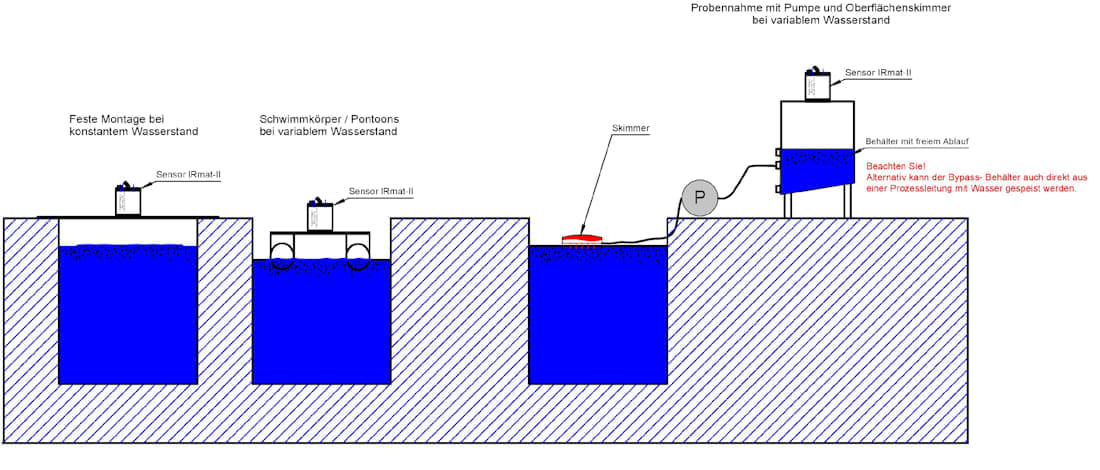
Oil-on-water detection is implemented by infrared scanning of the water surface:

  • Large-area projection of infrared beams onto the water surface.
  • The probe detects the optical interferences caused by oil on the water surface.


This method can also be affected by interfering factors:

  • The influence of extreme ambient light with fluctuating intensity
  • Strong wave motion on the water surface
  • Floating debris covering the surface


Minimising the effects of these interferences:

  • Through suitable device design.
  • Through the selection of the measuring point location.


The IRmat model (IR-21) is already in use in many applications:

  • Oil at drinking water reservoirs
  • Turbine oil in power plants
  • Hydraulic oil
  • Oil in cooling water
  • Heat exchanger oil
  • Oil in process water
  • Oil in retention basins
  • Direct discharge into rivers / lakes
  • Discharge into public sewer systems
  • Water throughput of turbines
  • Water from various collectors
  • Rainwater

Optical interferences at the oil/water borderline allows the monitoring of very low amounts of oil. The modulation of the projected IR- light ensures for a nearly 100% DC-light compensation, so that ambient light does not affect the measured values.

Contact

Looking for the right solution?

Benefit from over 40 years of experience, field-proven measurement technology and personal advice. Together, we will find the right solution for your application. Visit our contact page and tell us about your project for a non-binding quote.